- Truck Parking Club
- Posts
- Tale Lites Issue 53
Tale Lites Issue 53
OOIDA's Fight for right to Repair - New Broker Accountability Rule Takes Effect

Michael Lombard
January 19, 2026
🛠️ What OOIDA Is Really Fighting For on Right to Repair
As years have passed, we have seen trucks go from an engine and axles, to just becoming straight up computers. But one quiet fight may end up deciding the future of small carriers: who controls truck repairs after you buy the truck.
Right to Repair has been discussed in trucking for years, usually in broad, feel good terms like fairness, access, competition. But what the OOIDA is fighting for right now is more specific, and more urgent.
At its core, this fight comes down to one question:
Do you actually own your truck, or are you just allowed to operate it?
Today, original equipment manufacturers, or OEMs, largely control:
Diagnostic software
Fault codes
Repair procedures
Calibration tools
Software updates
Emissions and aftertreatment resets
In many cases, only OEM dealerships or OEM approved facilities can legally or practically access this information.
That means even if:
You own the truck
You pay the loan
You cover insurance
You pay for maintenance
You may still not be allowed to fully repair it yourself or take it to an independent shop of your choosing.
OOIDA, and many truckers’ stance is: If you own the truck, you should own the right to fix it.
What OOIDA Is Actually Pushing For
OOIDA isn’t asking for vague promises or optional access. They want enforceable federal protections that guarantee truck owners and independent shops access to the same tools dealerships have.
1. Equal Access to Diagnostic Data
Not delayed access.
Not partial access.
Not expensive “pay per use” portals.
OOIDA wants owner operators, small fleets, and independent repair shops to have access to the same fault codes, system data, and repair instructions that dealerships receive.
Without equal access, the repair market isn’t competitive, it’s controlled.
2. The Right to Choose Where You Repair
When OEMs restrict software and diagnostic access, they effectively force repairs into dealership networks, even when:
Dealers are backed up for weeks
The repair is minor
The truck is out of route
The cost is significantly higher
Even though I think dealerships may deserve it, this isn’t a direct attack on them. It’s about not being trapped by them, and breaking down mechanical monopolies.
3. Protection Against Forced Downtime
As we say at Truck Parking Club, time and fuel is money, so extra downtime is a killer.
When only certain facilities can perform:
Emissions resets
Software reprogramming
Aftertreatment diagnostics
Small carriers lose flexibility and leverage.
4. Stopping OEM Lock In Before It’s Normalized
The deeper concern is where this entire trend leads.
Unchecked, trucking could move toward a future where:
Trucks can only be serviced by OEM networks
Repairs require ongoing subscriptions
Software updates dictate how and where trucks operate
Ownership becomes conditional, not absolute
OOIDA wants to stop that future before it becomes standard practice.
Why Small Carriers Have the Most at Stake
Large fleets can absorb:
Dealer wait times
Higher labor rates
Redundant equipment
Maintenance contracts
Small carriers can’t.
For a 1-5 truck operation:
One “dealer only” repair can wipe out a week
One forced tow can erase a month of profit
One locked diagnostic can turn a minor issue into a major shutdown
Right to Repair is something small carriers need to survive, especially in challenging times like these last few years. Repairs have definitely been a top cause for what has driven carriers out of business.
Critics Argue about Safety and Emissions.
OOIDA made it clear: this isn’t about
Disabling emissions systems
Avoiding safety regulations
Circumventing federal requirements
It’s about having access to the tools required to comply affordably and efficiently.
This fight ties directly to:
Rising maintenance costs
Extended downtime
Shrinking margins
Reduced independence for owner-operators
Increased consolidation across trucking
OOIDA is asking the industry to decide now:
Are truckers owners, or just operators of OEM controlled assets?
Why This Issue Isn’t Going Away
Trucks are only becoming more software driven. OEM influence is only growing. That makes Right to Repair one of the most important long term structural issues in trucking, even if it doesn’t show up on the load board. OOIDA is pushing for clarity now, because once control is lost, it’s rarely given back.
Tale Lites Take
We are seeing this same issue for peoples’ passenger cars, and the Right to Repair becoming a reality in trucking, can hopefully spearhead taking on this type of usury for the general public. All of this correlates with the suspect of newer technology being built to break, or planned obsolescence. If the manufacturer is knowingly making a product designed to fail at a certain point, and then they’re the only one’s who can fix, replace, or upgrade it, is that not a form of entrapment?
What are your thoughts? For Driver Submissions, questions, and comments contact me at: [email protected] or Text me directly at 423-275-2444
Tale Lites Throwback
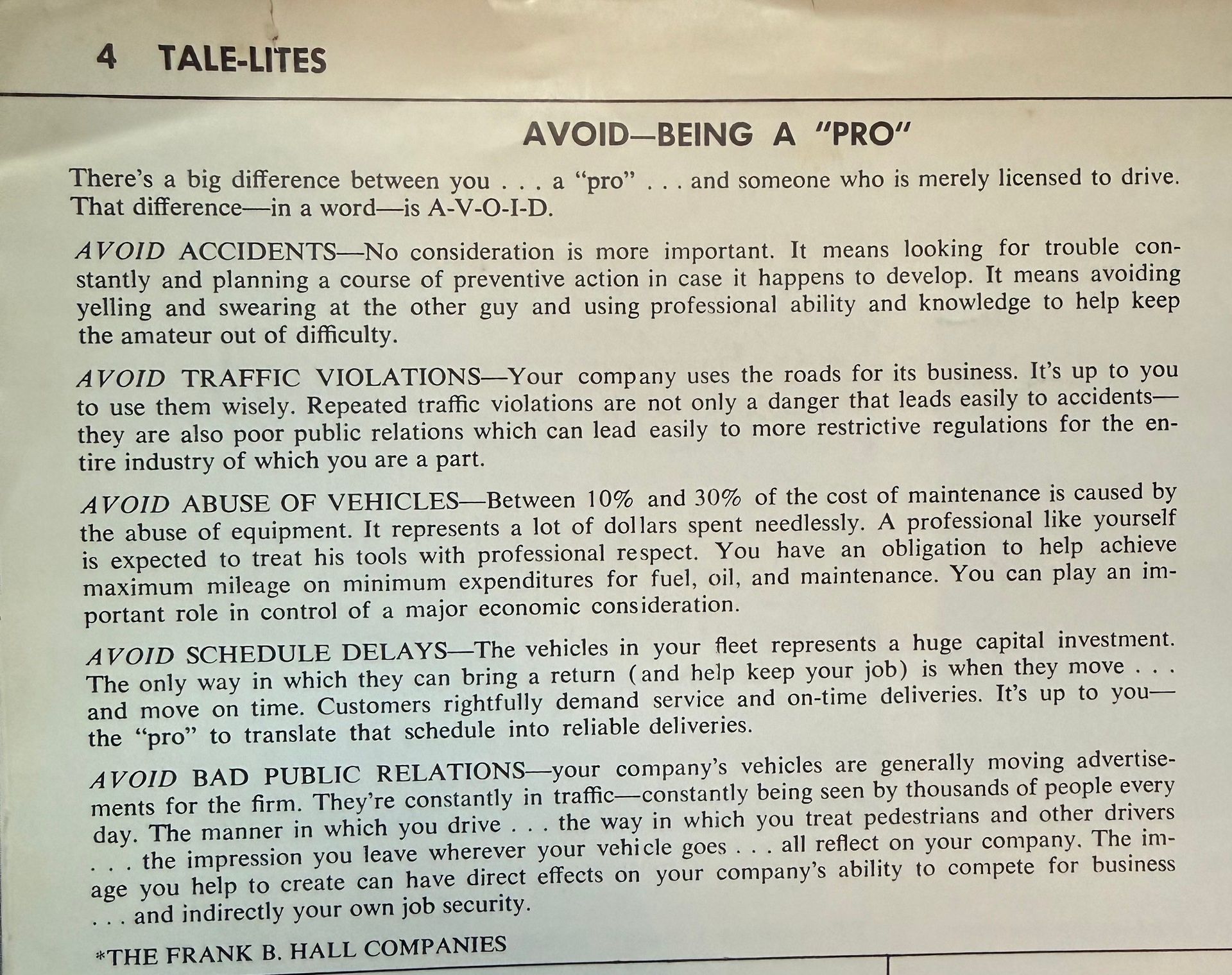
Great Tips on how to avoid being a “Pro” from Tale Lites in 1969
Broker accountability Rule Congress ordered over 10 years ago is LIVE!
As of Friday, January 16, the FMCSA now has the authority to suspend the operating authority of brokers and freight forwarders who fail to maintain the federally required $75,000 minimum financial security, and don’t fix it within seven days.
The change is a big win for truckers and owner operators, who have argued that weak enforcement allowed bad brokers to operate with little consequences or accountability.
This is something OOIDA has specifically pushed for. For nearly 15 years!
“OOIDA welcomes FMCSA’s Final Rule on Broker and Freight Forwarder Financial Responsibility,” said OOIDA President Todd Spencer. “This is a step forward that helps make sure truckers get paid what they’re owed on time in cases of theft, damage, and insolvency.”
What the New Rule Does
The final rule includes five major provisions:
1. Assets Must Be Readily Available
Only certain assets qualify toward the $75,000 requirement:
Cash
Irrevocable letters of credit from federally insured banks
U.S. Treasury bonds
2. Immediate Suspension Authority
FMCSA can suspend a broker’s or freight forwarder’s authority if their financial security drops below $75,000 and is not replenished within seven calendar days.
3. Mandatory Reporting of Financial Failure
If a surety or trustee becomes aware that a broker is experiencing financial failure or insolvency, it must:
Notify FMCSA
Begin cancellation of the bond or trust
FMCSA will then publish a notice in the Federal Register.
Note: Filing for bankruptcy under Title 11 does not automatically count as insolvency under this rule.
4. Enforcement Against Sureties and Financial Institutions
Surety companies or financial institutions that violate federal broker bond laws may face:
Monetary penalties
A mandatory 3 year ban from providing broker financial security
5. Who Can Serve as BMC-85 Trustees
Loan and finance companies are no longer eligible to provide trust funds for BMC-85 filings.
This signals progress, but it’s not a finish line.
OOIDA supports the rule but says it doesn’t go far enough.
“Most importantly, the rule requires FMCSA to suspend brokers who do not maintain the minimum $75,000 bond,” Spencer said. “This will assist carriers in determining if a broker has legitimate finances before hauling a load. While this is progress, it does not solve the entire problem.”
That problem, according to OOIDA and truckers, is broker transparency. A heavily debated topic across all social media platforms.
Transparency Still a Major Issue
Federal regulation 49 CFR § 371.3 requires brokers to keep detailed transaction records and allow carriers access to them. But many truckers say the rule is routinely ignored or outright evaded.
Frustration boiled over in May 2020, when hundreds of truckers traveled to Washington, D.C., to protest. OOIDA also petitioned FMCSA to strengthen transparency enforcement, drawing attention from the White House.
FMCSA proposed new transparency rules in 2024, receiving nearly 7,000 public comments, but never finalized them. The agency now says a second notice of proposed rulemaking is expected in May.
Why This Rule Exists
The broker financial responsibility requirements were originally mandated under the Moving Ahead for Progress in the 21st Century Act, commonly referred to as MAP-21, signed into law in 2012.
FMCSA issued the final rule in November 2023, with compliance initially set for January 16, 2025. That deadline was pushed back one year due to delays with FMCSA’s new registration system.
In December, FMCSA released a Frequently Asked Questions document to help brokers and carriers navigate the new requirements.
This rule finally gives FMCSA teeth to shut down undercapitalized brokers, but many truckers say real accountability won’t come until transparency rules are enforced just as aggressively.
It’s hard to gauge whether full transparency would be good or bad. I think in the short term it would be a great benefit to carriers, but it also could open up Pandora’s Box to further create a race to the bottom. I’ve heard arguments on both sides, and where there is nothing that can be done in the short term, the best way to have transparency is to build great relationships with who you do business with.
📩 What are your thoughts?
Reply to this email or text (423) 275-2444
🩺 Health Tip of the Week: What is fiber, and why you Need it!
Fiber is a type of carbohydrate found in plant foods that your body can’t digest. Instead of being broken down for energy, fiber moves through your digestive system, helping regulate digestion, blood sugar, and cholesterol. There are two main types:
Soluble fiber dissolves in water and helps control blood sugar and cholesterol.
Insoluble fiber adds bulk to stool and keeps digestion moving.
Why fiber is important
Getting enough fiber supports:
Better digestion and regular bowel movements
Heart health by helping lower LDL (“bad”) cholesterol
Blood sugar control, reducing spikes and crashes
Weight management by helping you feel full longer
Gut health, feeding beneficial gut bacteria
Most adults need 25–38 grams of fiber per day, yet many people fall well short.
Best food sources of fiber
Fruits: berries, apples (with skin), pears, oranges
Vegetables: broccoli, Brussels sprouts, carrots, leafy greens
Whole grains: oats, brown rice, quinoa, whole-wheat bread
Legumes: beans, lentils, chickpeas, split peas
Nuts & seeds: chia seeds, flaxseed, almonds, walnuts
Simple tip to start today:
Add one high-fiber food per meal—berries at breakfast, beans at lunch, veggies or whole grains at dinner.
Fun Fact: 1g of fiber negates 1g of regular carbohydrates. For example, if something has 20g of carbs per serving, but also has 7g of fiber, you’re only consuming net 13g of carbs.
Partner Post of the Week
Check out these California views from our Partner D&D Expeditors! You can get $20 off your next booking by using the promo code dnd20
@dndexpeditors #fyp #california #I8 The views never get old out here.
Truck Parking Club Partner Program
Do you create content for truckers, want to help solve the truck parking crisis, and an opportunity to give drivers FREE parking? Let’s work together! Click below to apply for Truck Parking Club’s Partner Program today!