- Truck Parking Club
- Posts
- Tale Lites Issue 78
Tale Lites Issue 78
NHTSA Blasts Robot Trucks - EPA Proposes Eliminating Limp Mode

Michael Lombard
July 15, 2026

🚨 NHTSA Calls Out Self-Driving Companies Over Emergency Scene Failures
The National Highway Traffic Safety Administration (NHTSA) has proposed loosening certain regulations for self-driving vehicles, including a recent proposal to eliminate the federal requirement for manual brake pedals in vehicles designed to operate without a human driver. Opponents of this have warned that the technology still isn't ready for widespread deployment.
Now, even NHTSA is publicly acknowledging one of the biggest concerns.
In a letter sent July 8 to autonomous vehicle developers, the agency said it has identified a "clear pattern" of driverless vehicles creating dangerous situations for first responders.
According to NHTSA, autonomous vehicles have repeatedly:
Driven into active emergency scenes.
Blocked ambulances and fire trucks.
Failed to recognize flashing emergency lights.
Ignored traffic cones, road flares, smoke, and fire.
The agency said these aren't isolated software bugs—they're fundamental safety failures.
"Every second matters when law enforcement officers, firefighters or paramedics are answering a call," NHTSA wrote. "The inability to detect and appropriately respond to such situations represents a functional insufficiency."
NHTSA has ordered meetings with autonomous vehicle developers before the end of the month to explain how they plan to address these problems.
The agency also made it clear that public confidence in self-driving technology must be earned, not assumed.
Industry Concerns Continue
Jay Grimes, OOIDA's Director of Federal Affairs, urged the U.S. Department of Transportation to establish a national framework that requires proven safety standards, independent testing, and complete transparency before allowing driverless heavy-duty trucks to operate on public highways.
My biggest concern is national security and the waterfall effects of job loss.
What do you think? For Driver Submissions, questions, and comments contact me at: [email protected] or Text me directly at 423-275-2444
🚚 Freight Market Watch
All-in rates (linehaul + fuel surcharge) on the DAT board, week of July 7:
Dry Van: ~$3.06/mile ▲ up 4 cents week over week
Reefer: ~$3.47/mile ▲ up 7 cents week over week — matching the 2021 all-time record
Flatbed: ~$3.68/mile — unchanged
At the Pump — Week of July 13, 2026
The relief was real. Then the rug got pulled.
After reaching $5.64 per gallon in May, the national average had fallen to approximately $4.58 per gallon by July 6. A decline of $1.06 over 10 consecutive weekly drops. Carriers were finally getting some breathing room.
Then it compounded. By July 10, a surge in diesel futures was being driven by two overlapping pressures: renewed Iranian attacks on tankers transiting the Strait of Hormuz, and Russia's temporary suspension of diesel exports — the result of weeks of Ukrainian drone strikes on Russian refineries hobbling domestic production and creating shortages that forced Moscow to hoard supply. U.S. diesel exports had already hit a record as Europe and Asia scrambled for cargoes, draining domestic inventories further.
Regional snapshot as of the July 7 EIA reading (last official data):
Gulf Coast: $4.23/gal — still your best fill, though the floor is rising
Midwest: $4.46/gal — saw the biggest recent drops; watch for reversal
East Coast: $4.69/gal
Rocky Mountain: $4.48/gal
West Coast (ex-CA): $4.86/gal
California: $5.43/gal — and climbing. California was still averaging $6.07/gal as of late June before the recent relief, and is structurally insulated from national trends.
♻️ EPA Proposes Ending DEF "Limp Mode"
We just covered in Tale Lites 75 what Daimler was doing to help with DEF issues, but now we even have some bigger news
On Thursday, the Environmental Protection Agency (EPA) announced a proposal that would completely eliminate DEF related engine derates and speed restrictions, also known as "limp mode" on any newly manufactured commercial trucks and other diesel powered equipment.
If finalized, trucks would no longer automatically lose power or be limited to reduced speeds simply because of a DEF system or sensor failure. Instead, drivers would receive visual and audible warnings, allowing them to continue operating until they can safely repair the issue.
Existing Trucks Could Benefit Too
The EPA is also asking for public comment on allowing manufacturers to apply similar software changes to existing trucks and diesel equipment already on the road, potentially giving current owners relief if manufacturers choose to participate.
More Changes to Emissions Rules
Alongside the DEF proposal, EPA announced several additional reforms aimed at reducing costs for the trucking industry.
The agency is proposing to:
Ease certain emissions warranty requirements while keeping most NOx reduction targets in place.
Give truck and engine manufacturers more time to comply with stricter Model Year 2027 emissions standards.
Allow temporary nonconformance penalties for engines that don't immediately meet the new standards, preventing production disruptions.
EPA estimates these changes could save the trucking industry roughly $12 billion, or about $6,000 per new truck.
What They're Saying
EPA Administrator Lee Zeldin called the proposal a "commonsense solution" that will improve reliability without sacrificing environmental protections.
Agriculture Secretary Brooke Rollins said the changes would help keep trucks, farm equipment, and other diesel powered machinery working instead of being sidelined by faulty emissions sensors.
Small Business Administrator Kelly Loeffler also praised the proposal, saying it would reduce unnecessary regulatory burdens while improving equipment reliability for truckers, farmers, and small businesses.
📩 What are your thoughts?
Reply to this email or text (423) 275-2444
🍽️ Recipe of the Week! - Crispy Chicken Hummus Wrap
INGREDIENTS
• 2 large low carb tortillas (like Mission Carb Balance/Find at Walmart)
• 1 can chunk chicken breast, drained (12.5 oz)
• 2 cups baby spinach
• 4 tbsp hummus (single serve cups)
• 1 cucumber, sliced thin
STEPS
Warm the tortillas: Warm 2 large low-carb tortillas (like Mission Carb Balance) in the microwave for 20 seconds to make them easier to roll.
Load the wrap: Spread 4 tbsp hummus across each tortilla, then layer on 1 can chunk chicken breast, 2 cups baby spinach, and 1 cucumber
Crisp in the air fryer: Roll the wrap tightly and place seam-side down in the air fryer at 370°F for 3-4 minutes to crisp up the outside.
Serve: Slice in half and eat. Wrap the other half in foil and refrigerate for later if needed.
Trucker tips:
Canned chicken is a trucker staple: no cooking, no mess, high protein.
Single-serve hummus cups (like Sabra snack packs) are sold at Walmart and most gas stations.
Pre-washed spinach bags require zero prep and last about a week in the fridge.
Swap cucumber for a handful of shredded carrots or sliced bell pepper if you want a crunch.
Macros (approx. per serving): 280 cal · 34g protein · 22g carbs · 7g fat
Partner Post of the Week
Rich is back on the road and finding great spots for parking! If you need safe parking use the promo code TWR20 for $20 off your next booking
Long Time Trucker Writes Book on the State of American Trucking Industry
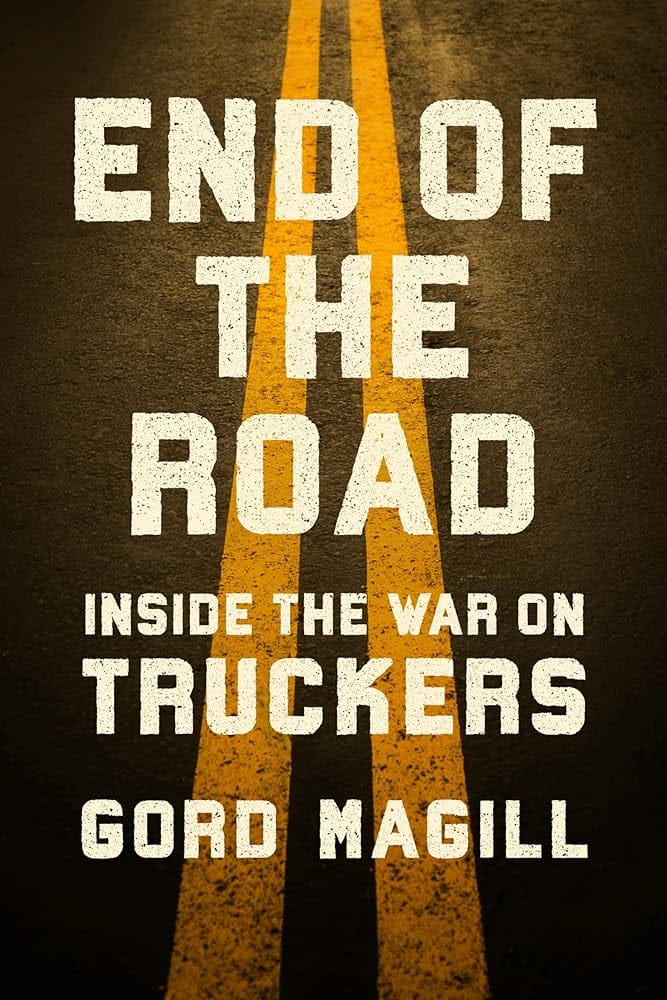
Is there a quiet war being waged against America’s truck drivers?
That’s the argument behind End of the Road: Inside the War on Truckers, a new book by longtime driver and writer Gord Magill. Magill claims the industry that once represented freedom and independence is being attacked on all fronts, from government regulations, in cab surveillance technology, corporate consolidation, and the push toward autonomous trucks.
God Magill has decades of experience including 4 seasons on ice roads in Canada, road trains in Australia, and over the road in the US. He argues that drivers today face tighter control, shrinking margins, and a future where human truckers may be pushed out altogether.
If you drive a truck, have driven, or have a family member who drives then this book is a must read.
You can order the book HERE and use the promo code 4TRUCKERS20 for a discount at checkout!
Truck Parking Club Partner Program
Do you create content for truckers, want to help solve the truck parking crisis, and an opportunity to give drivers FREE parking? Let’s work together! Click below to apply for Truck Parking Club’s Partner Program today!